
Longevity & Health Insight · 16 Sept 2026
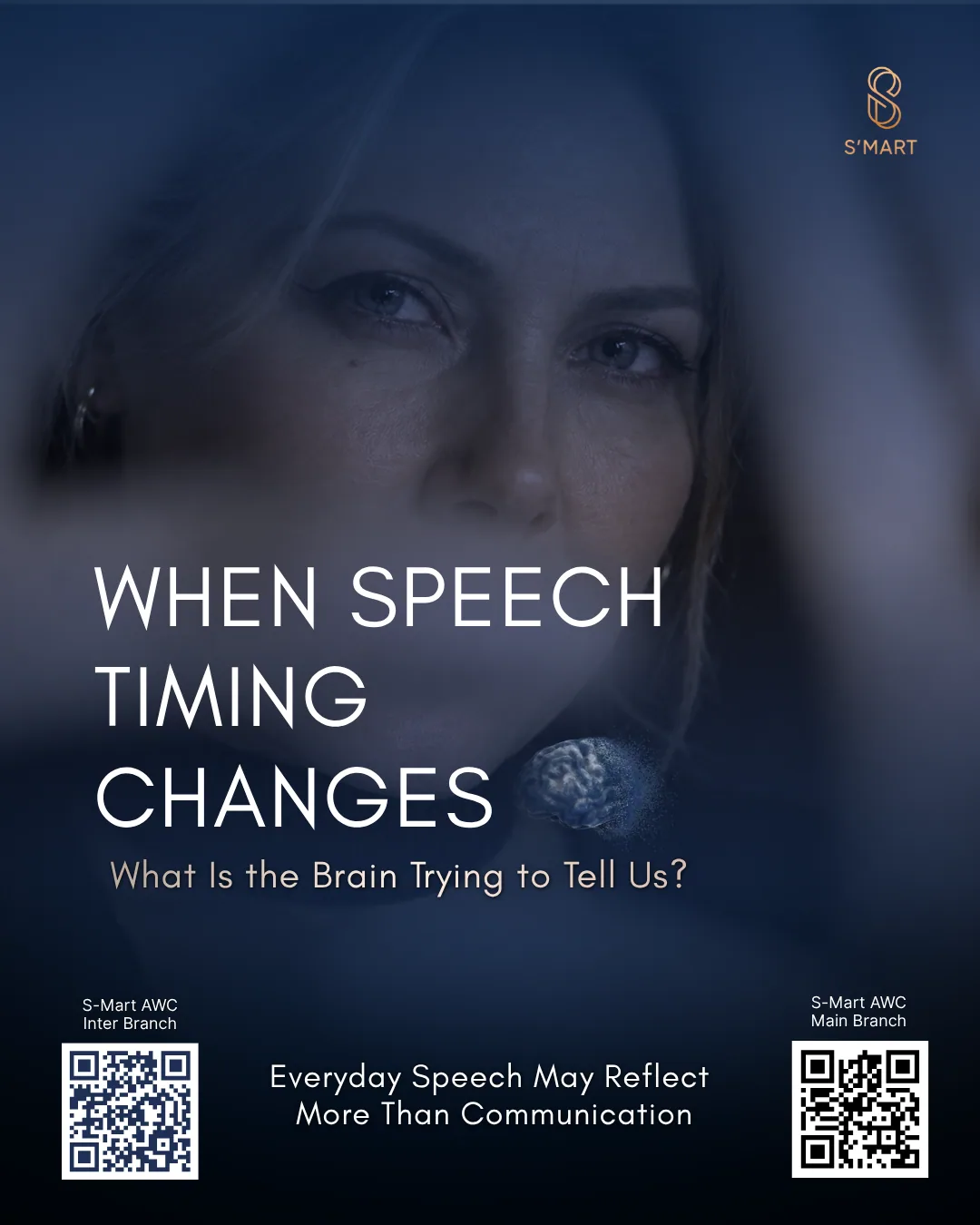
When Speech Timing Changes, What Is the Brain Trying to Tell Us?
Everyday speech patterns, such as word-finding pauses, filled pauses, or sentence formulation speed, may reflect certain aspects of executive function. However, speech patterns alone cannot diagnose brain-related conditions. If changes in speech, memory, or thinking persist or affect daily life, medical assessment is recommended.
Everyday Speech May Reflect More Than Communication
Have you ever noticed the way you or someone close to you speaks in everyday conversations? Sometimes, we may pause to search for a word, or use filled pauses such as “uh” or “um” within a sentence.
These natural speech patterns may not be merely habitual. They may also provide information that can be studied alongside brain function, especially the higher-level thinking system known as Executive Function.
Executive Function refers to a group of cognitive processes that help us plan, hold information in short-term memory, control distractions, and shift attention according to different situations.
As we age, certain aspects of thinking may naturally change. Paying attention to these changes is one part of long-term brain health care.
Why Is Speech Timing Related to the Brain’s Thinking System?
Natural everyday conversation requires coordination across several parts of the brain, including word retrieval, sentence organisation, and sequencing of thoughts.
Research suggests that speech timing may be associated with individual differences in executive function.
- Pauses: Short pauses or longer pauses before continuing speech may reflect the process of searching for words or organising thoughts.
- Filled pauses: Words such as “uh” or “um” may appear while a person is thinking or searching for the right word.
- Processing speed: Speaking speed and sentence formulation may be associated with thinking processes and the ability to shift attention.
One advantage of studying speech patterns is that speech occurs naturally in daily life. It may be used to observe changes in communication patterns over time, rather than relying only on repeated traditional testing methods.
Points to Observe in Daily Life
If you want to pay attention to changes in communication and thinking processes at an initial level, you can observe the following behaviours during conversation.
1. Taking Longer to Find Words: A person may become stuck, struggle to recall the word they want to use, or need more time to retrieve words.
2. Changes in Speech Rhythm: Speech may become slower, or there may be more pauses between sentences than before.
3. Slower Topic Switching: When changing conversation topics or responding to new information, a person may need more time to think and organise their response.
However, speech patterns can change due to many factors. Therefore, no single speech feature should be used alone to conclude a health condition or brain abnormality.
Understanding Additional Risk Through APOE Genotyping
In addition to observing everyday changes, certain genetic tests may provide additional information for long-term health assessment.
One example is APOE Genotyping, which tests variations in the APOE gene. This gene has been studied for its association with Alzheimer’s disease risk, as well as cardiovascular health.
For people with a family history of Alzheimer’s disease, memory decline, or cardiovascular disease, consulting a doctor about whether further testing is appropriate may be considered.
At S-MART AWC Clinic Bangkok, APOE Genotyping is available as part of individual risk assessment. The result should be interpreted together with medical history, other risk factors, and a doctor’s evaluation.
A genetic result alone cannot confirm that a person will develop a disease in the future.
Ways to Support Executive Function and Brain Health
To support cognitive flexibility and brain health at different stages of life, you can take care of yourself in the following ways:
- Practise varied communication: Storytelling, describing pictures, or discussing new topics can help use word retrieval and thought organisation skills.
- Do activities that require cognitive flexibility: Examples include brain-training games, learning new skills, or reading and summarising the content in your own words.
- Take care of overall physical health: Getting enough quality sleep, exercising regularly, and managing stress are all part of supporting overall physical and brain health.
Paying attention to speech rhythm and communication fluency may help us notice changes in daily life and guide more suitable health care and lifestyle adjustments.
If changes in speech, memory, or thinking processes continue over time or affect daily life, medical assessment is recommended to identify the cause appropriately.
Reference
Wei, H. T., Kulzhabayeva, D., Erceg, L., Rose, M. K., Spencer, K. A., Robin, J., Bialystok, E., & Meltzer, J. A. (2025). Natural speech analysis can reveal individual differences in executive function across the adult lifespan. Journal of Speech, Language, and Hearing Research, 68(12), 5708–5726. https://doi.org/10.1044/2025_JSLHR-24-00268
Related articles
Related articles



S-MART AWC · 01
Headquarters (Prasert Manukitch)
Address S-Mart AWC Building, 35/2 Soi Prasert Manukitch 29 (Maylab), Prasert Manukitch Road, Chorakhe Bua, Lat Phrao, Bangkok 10230
S-MART AWC · 02
Inter Branch (Phloen Chit–Chidlom)
Address Room G102, Ground Floor, President Tower Shopping Center (connected to Inter Bangkok), 973 Phloen Chit Road, Lumphini, Pathum Wan, Bangkok 10330